
Financial highlights
Last trade 50.42€
Variation +4.73%
16/10/2026 - 05:38 PM
data source: Investis Digital
Financial highlights
Last trade 50.42€
Variation +4.73%
16/10/2026 - 05:38 PM
data source: Investis Digital
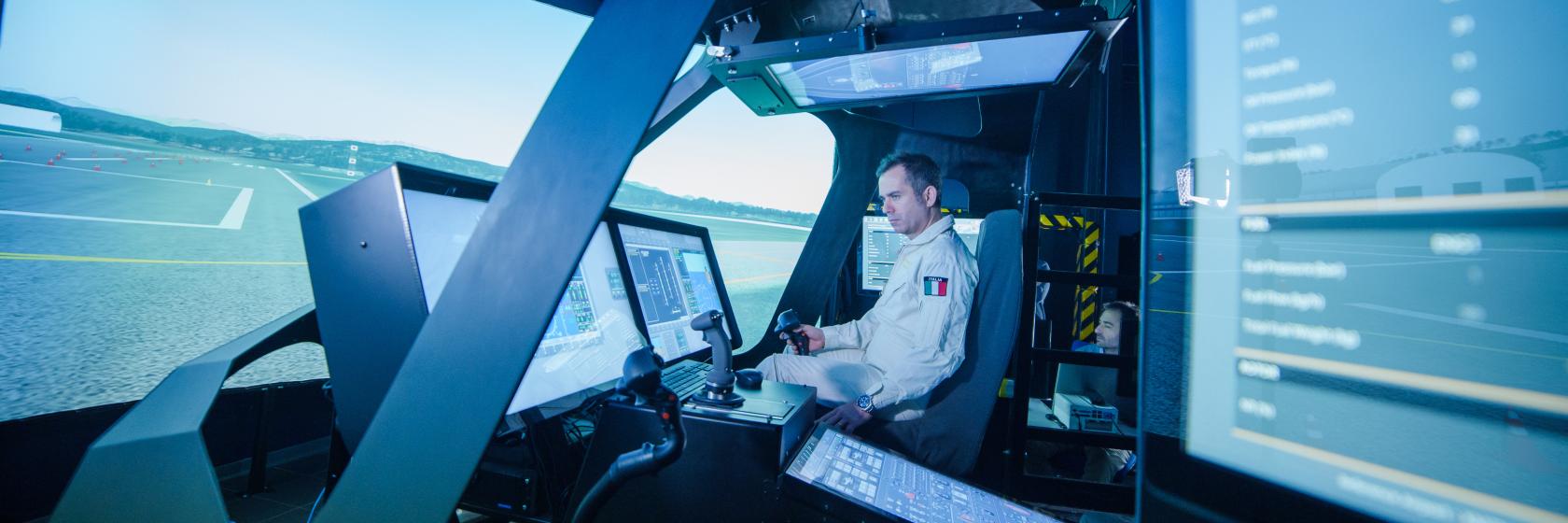
Digital Twin technology is significantly reducing the time taken to develop new rotary wing platforms and solutions. It is also a vital contributor towards our efforts to make the entire helicopter lifecycle more sustainable.
The image that springs to mind when discussing the use of Digital Twins in the rotorcraft sector is a 3D model of a helicopter spinning on a computer screen. Yet the value of Digital Twins goes far beyond advanced modelling – and they are bringing benefits from both an engineering and a sustainability perspective.

Digital Twins are a precise virtual copy of a real-world product or system. They provide dynamic digital replicas of key elements from a single component to a whole helicopter, integrating real world data and physics based simulations. The applications are diverse, making it possible to simulate real-world mission profiles, critical scenarios, evolving weather conditions, different aircraft configurations, and component wear. All in a fraction of the time it would take if relying on traditional prototyping and analytical techniques.
Federico Rivalta leads the team responsible for Leonardo Helicopters’ Digital Twin development. He explains: “Over the past two years, we have accelerated our efforts in the field of Digital Twins. They are supporting almost every aspect of the work we do – helping us to anticipate customer requirements more effectively, speeding up engineering development, enhancing flight activities while reducing dependencies on real helicopter testing, and strengthening our synthetic training capabilities.
“It’s sometimes overlooked that Digital Twins also have a direct and measurable impact on the sustainability of our helicopters. For example, the use of Digital Twins allows us to optimise development missions, ensuring that the actual helicopter platform is only in the air strictly when necessary, cutting fuel consumption and associated emissions, waste, and enhancing safety.
“Reducing physical testing and flight campaigns directly decreases the number of flight hours dedicated to live flying. For example, we estimate that use of Digital Twin techniques has allowed us to achieve a 20% reduction in the number of flight hours required for engineering development of a new function.
“Another key element is predictive maintenance. Thanks to Digital Twin analysis, we can more accurately predict component wear, reducing waste from unnecessary part replacements, material disposal, and avoidable maintenance activities.”
No single Digital Twin can fulfil every requirement – whether that’s from engineering, production, training, or maintenance, Rivalta says. “So instead, we’re creating different simulation solutions that are adapted to the particular needs of a function or business area.”
We’re also using Digital Twins to optimise the design of new components and systems, for example by performing Human Machine Interface (HMI) evaluations in simulated environments using virtual reality. This shortens development timelines and reduces the number of physical prototypes that need to be built.
And as customers seek to enhance operational capability, Digital Twins provide a valuable way to evaluate new mission functionalities in partnership with the Leonardo team. For SAR operators, this could involve a customisation that supports crews when performing a rescue operation in a confined area, or it could enable offshore operators to simulate landings on offshore platforms in demanding weather conditions.

Complex multi-domain operations involving air, land, sea, space and cyber assets are fundamental to modern warfare. Here too, Digital Twins make a positive contribution by replicating these scenarios in a highly realistic way to aid mission rehearsals and to refine concept of operations. Indeed, Digital Twins are an essential element of LX-Arena – our new immersive mission simulation environment (see separate article for more details).
How does Rivalta sum up the value of Digital Twins when it comes to sustainability? “I would say that Digital Twins are an important enabler for more sustainable operations. The technology is evolving very rapidly and within Leonardo we are committed to using the power of Digital Twins to ensure more efficient, safer, and lower impact operations in close collaboration with our customers and partners.”


 Media Hub



 Civil/Parapublic


