
Financial highlights
Last trade 50.42€
Variation +4.73%
16/10/2026 - 05:38 PM
data source: Investis Digital
Financial highlights
Last trade 50.42€
Variation +4.73%
16/10/2026 - 05:38 PM
data source: Investis Digital
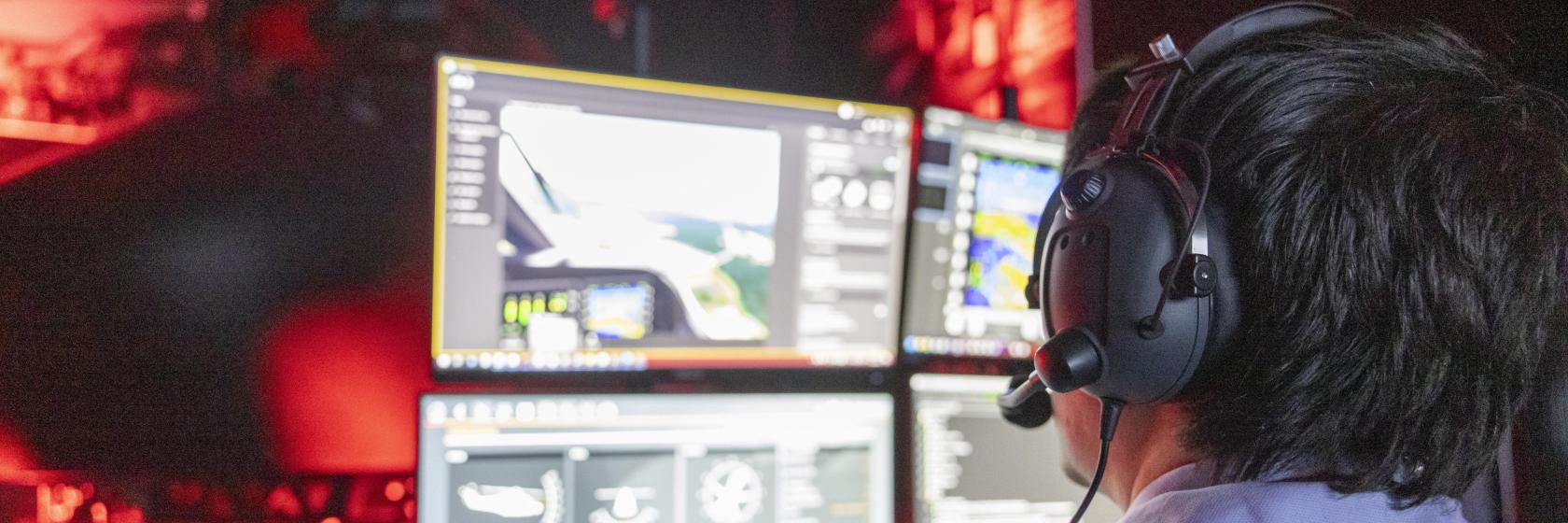
LX-Arena is our brand new immersive mission simulation environment. It builds on Leonardo Helicopters’ decades of expertise in simulation and training, creating a virtual arena that enables end-users to rehearse the most demanding operations in a collaborative ‘live’ setting.
In a darkened room inside the Alessandro Marchetti Training Academy in Sesto Calende, a wall of screens blink into life and a multi-force military operation is unfolding at pace. It is a coordinated reconnaissance and strike mission involving space, air and naval assets, operating in concert to pinpoint and counter threats.
The mission is not real – it is a simulated scenario, but it feels very real and that is the point. This is LX-Arena, a federated virtual environment that explores a concept at the heart of modern military doctrine – interoperability across domains.
Interoperability is central to today’s military operations, enabling forces to interact, communicate and conduct joint operations more effectively. It’s also becoming increasingly important in civil missions such as firefighting, and search and rescue as air and ground assets work in unison. But how do you test interoperability in a realistic setting?
LX-Arena delivers exactly that capability, meeting the growing demand for advanced mission simulation capable of connecting multiple platforms across domains. The ‘arena’ is built to mirror real-world operations by harnessing the latest advances in AI and digital twin technology. It offers mission-specific training for everything from a single asset through to complex multi-force operations that involve a mix of air, land, and naval assets.
Developed, tested and refined over the past 12 months, LX-Arena allows multiple simulation assets ranging from Full Flight Simulators to Mission Training Devices located both on site and remotely to connect seamlessly and then participate in complex mission scenarios. The environment can also connect simulation assets based at customer sites and interact with platforms conducting live flying – delivering a true Live, Virtual, Constructive (LVC) training concept.
We have presented LX-Arena to potential customers with excellent initial feedback and will continue to collaborate with end-users in the coming months.

Mattia Cavanna, Vice President Technology and Innovation, says LX-Arena is mission-focused: “We were very clear from the outset that LX-Arena would be dedicated to mission simulation rather than flight simulation. This reflects the fact that the end goal for customers, whether military or civil, is not simply to fly, but to execute their mission in the safest and most effective way.
“It brings a number of practical benefits for customers. They can refine Concept of Operations (CONOPS) and dramatically reduce the time needed to validate new requirements, for example.
“The simulation is also highly representative of the real-world setting. It allows multiple forces to rehearse missions collaboratively to enhance mission effectiveness, while also reducing risk by minimising the amount of live flying required. From a Leonardo Helicopters perspective, this means we can speed up engineering development, integration of new technologies and sensors, and test new offerings with customers.”
LX-Arena is designed to be adaptable, with applications for military, government, and civil missions. It can recreate scenarios ranging from planning and execution of a reconnaissance and strike mission through to a mountain search and rescue operation, as well as co-ordinated firefighting missions involving both aerial and land assets.
Andrea Maccapani, Technology and Innovation Military Products Manager, coordinates the team that has developed LX-Arena. He believes one of its most valuable benefits is closer collaboration with the end-user. “It enables us to work side-by-side with the customer team, in the same room. We see exactly what they see; we share concerns and ideas. The mission unfolds right there, and we can refine requirements and pursue solutions together.
“We can fine tune CONOPS, plan the mission, execute it and then conduct a full debriefing – all in a setting that mirrors real-world operational challenges.”

Using a common open standard, LX-Arena joins the dots between Leonardo’s advanced simulation assets, including Full Flight Simulators, VxR training devices, and mission task simulators, all delivering the highest levels of fidelity. They can be combined with end-user simulation devices such as naval and main battle tank simulators as well as aircraft performing live flying if required.
It provides a fully cyber-secure environment, enabling sensitive mission rehearsals to be conducted in what is essentially a ‘sterile’ setting.
The arena itself is a dedicated space featuring wall-to-wall hi-resolution displays with satellite feeds. There are workstations where the mission training scenario can be managed and analysed, alongside role play stations – which enable ‘wargaming’ activities, including command and control of both blue and red forces.
“We start with the pivotal role of helicopters at the centre of the mission,” says Maccapani, “but then expand the mission simulation to encompass other assets. It allows end-users to explore the interaction between crewed and uncrewed rotary wing platforms, fixed-wing aircraft, and other assets. We are adding an operational simulation option to procedural and engineering simulators.
“Participants can see each other, speak to each other and exchange data in a synchronised way – mirroring the requirements of real-world missions.”
A scenario manager has overall control of the arena and can introduce real-time changes – for example injecting a new threat, degrading the capabilities of an asset, altering the weather conditions, or simulating downed power lines in the location.
Giuseppe Pietroniro: Head of Simulation and Training Systems, Leonardo Aircraft Division
“LX-Arena represents a big leap forward. For the first time, we can connect two worlds, bringing together fixed-wing and rotary-wing mission simulation in a single environment. Collaborating across the different parts of the Leonardo business has been vital in making this possible. We have already successfully connected the M-346 jet trainer and there is the potential in future to link other platforms such as the C-27J military transport.
“For pilots, it means they train as they fight. The mission they experience is just like in the real world. It is a multi-domain environment; they need to collaborate with other assets like ships and helicopters. There are connected aircraft performing live flying. Therefore, their mindset is about executing the mission, not simply completing a training exercise.
“It is a quantum shift in how we train crews because they learn not only how to manage the aircraft but how to operate in an increasingly complex battlespace.”

Using digital twin techniques, LX-Arena can recreate the exact environment and location for a mission rehearsal. Here are three examples of how it could support future customer interoperability requirements:
Coordinated reconnaissance and strike mission
0. Satellite reconnaissance: Satellite tasked with monitoring the areas detects potential threats
1. AW Hero launch and recon: AW Hero takes off from a ship, while Proteus conducts ASW/ASuW operations
2. Target identification: AW Hero operator identifies threats. Command authorises engagement
3. Helicopter intervention: AW119 receives coordinates and moves to tactical positions
4. Observation and coordination: Blue forces helicopters validate and mark the threats
5. Engagement and battle damage assessment: Combat helicopter neutralises the target. AW Hero performs BDA activities
Mountain search and rescue
0. Incident detection: 112 receives a distress call and initiates the alert.
1a. AW Hero launch and recon: AW Hero is deployed to survey the area using Augmented Target Recognition (ATR) capabilities, while sending a live feed to the ground control station (GCS)
1b. Operators Recon: Operators identify the last known position and assess dangers while receiving information form the GCS
2. Target identification and coordination: AW Hero identifies the target and provides coordinates to Operators and to AW169 for extraction
3. Rescue Phase: AW169 performs recovery of casualties using hoist
4. Extraction and evacuation: AW169 flies to the hospital and Operators return to base

Firefighting operations
0. Satellite detection: A monitoring satellite detects an emerging wildfire. Operations centre validates the thermal anomaly, deploys ground teams, and activates aerial response
1. AW Hero launch and recon: AW Hero performs short-range reconnaissance, streaming electro-optical and infrared (EO/IO) data to the operations centre and ground personnel
2. AW139 launch: An AW139 takes off, equipped with bambi bucket for firefighting. Conducts multiple precision drops after receiving coordinates from AW Hero and GCS
3. Containment and final verification: Fire intensity falls dramatically. Ground teams neutralise remaining hotspots. AW Hero conducts a final perimeter sweep to confirm no further outbreaks
Rather than viewing LX-Arena as a ‘stand-alone’ mission simulation offering, in future it could be integrated with other simulators developed by end-users or other providers to create a powerful extended synthetic environment.
This is possible in part thanks to the LX-Arena’s use of NATO-standard protocols for data exchange. The approach creates a ‘common language’ enabling multiple simulators hosted by other arenas to ‘talk’ to each other and operate collaboratively.
And as mission simulation requirements evolve, so too will the capabilities of LX-Arena to stay ahead of the technology curve. Maccapani explains: “We are working collaboratively with other Leonardo divisions to widen the network and operate – virtually – with additional simulators, platforms and technologies. We’re excited by the potential of LX-Arena, and we look forward to working with our customers to make the most of its capabilities.”

 Media Hub



 Civil/Parapublic


