
Financial highlights
Last trade 50.42€
Variation +4.73%
16/10/2026 - 05:38 PM
data source: Investis Digital
Financial highlights
Last trade 50.42€
Variation +4.73%
16/10/2026 - 05:38 PM
data source: Investis Digital
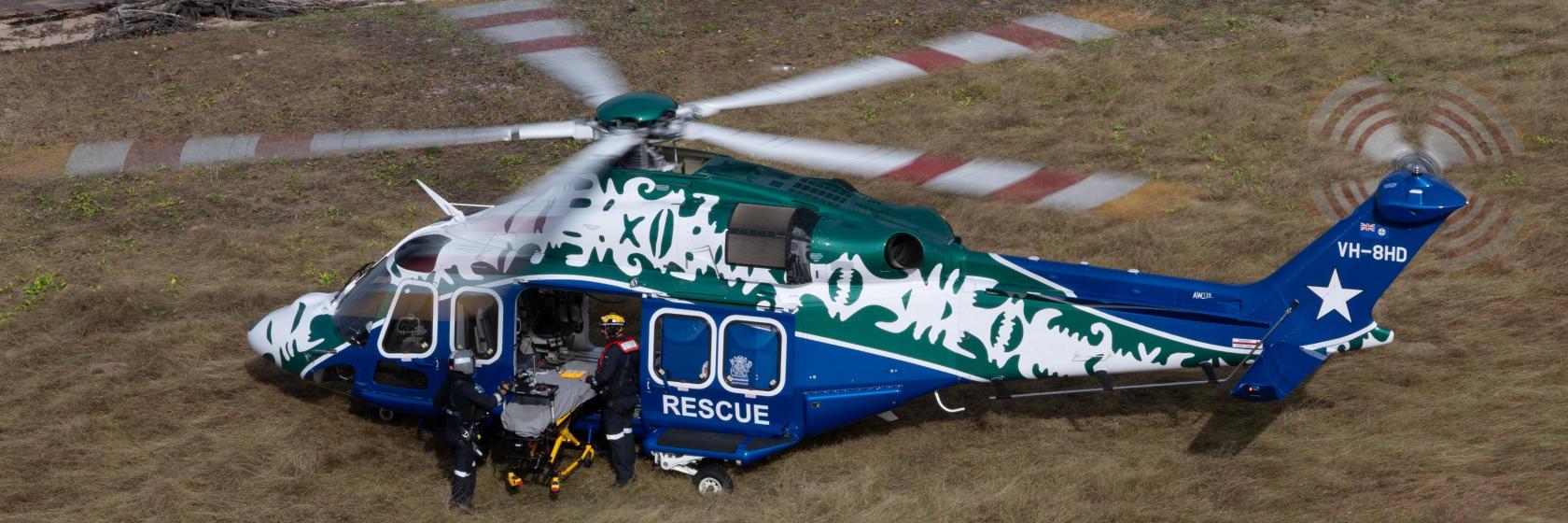
For more than 27 years Babcock has served the Torres Strait community off the northernmost tip of Queensland, Australia, providing a vital 24/7 Helicopter Emergency Medical Services (HEMS) capability, today known as the Lagaw Kuyup Rescue Service. The service is fully funded by the Queensland Government under a service agreement Babcock holds with Queensland Health. The arrival in 2025 of two multi-mission AW139 helicopters opened a new chapter in a remarkable story.
In one of the most remote corners of Australia, the Lagaw Kuyup Rescue Service can only be described as a lifeline. Operating around the clock, the service, powered by two AW139 helicopters, enables rapid access to emergency healthcare for hard-to-reach island locations in the Torres Strait as well as the Northern Cape York peninsula.

With hundreds of islands in the archipelago and limited road transport options, transfer by helicopter is almost invariably the only way to get sick patients to hospital. Demand for the service is high. In the past 12 months, Babcock crews performed 546 missions and over 500 flying hours. Patients are usually transported from one of 17 primary health care centres dotted around the island chain to the main hospital on Thursday Island.
Crews also respond directly to emergencies, including motor vehicle accidents and other critical incidents in remote locations where there is no nearby health facility. In these cases, patients may be retrieved from the scene and flown directly to hospital, ensuring timely access to specialist care when every minute counts.
“Operating in the Torres Strait is a unique responsibility,” says Duncan Milne, Managing Director, Aviation and Critical Services, Babcock Australasia.
“We don’t just provide a service – we’re right at the heart of the community. We understand how much people rely on us to be there for them. Strong community partnerships are essential to the work we do and we’re the only aeromedical provider in the area, so it’s critical that we provide a fast, reliable, high quality HEMS service.”
The operating environment itself is highly demanding. “We operate in a tropical climate, in an area that’s prone to extreme weather conditions. The wet season presents one of the greatest operational challenges for our crews, with rapidly changing weather. We need to perform continuous risk assessments and make sure that we balance mission requirements with the safety of patients and crew.
“This is where the knowledge and experience of our pilots in the region comes to the fore – ensuring that flights are planned and conducted safely and efficiently.”

Crews can be called on to meet a wide range of missions, including inter-hospital transfers, primary medical evacuation, and search and rescue in regional and remote Aboriginal and Torres Strait Islander communities. Aircraft are also available to support taskings from other government departments, including Queensland Fire Department and Queensland Police Service.
Babcock’s operations in the Torres Strait started a new era in April 2025 with the entry into service of two state-of-the-art AW139 helicopters. The AW139 replaced the previous Bell 412 fleet that provided the backbone of the HEMS operation for many years.
The AW139 has brought a significant increase in speed, range and operational capability. “It’s extended our range considerably,” explains Matt Doyle, Head of Customer Service and Delivery, and an experienced helicopter pilot. “We can get to incidents more quickly and we can fly up to 1,100km or five hours’ flying time, allowing for extended searches and a reduction in refuelling stops to reach the outer islands in bad weather.
“We have improved technology on board too. The AW139 has an electro-optic/infrared (EO/IR) system that enhances our night search capability, and it has a higher weight capacity so that we can install more specialist equipment and carry more fuel.”
The aircraft are equipped with a Queensland Ambulance Service (QAS) compatible power-loader stretcher system that makes patient transfers smoother as well as a climate control system to maintain a more comfortable temperature for patients, crews, and paramedics. Other features include a floatation system, winch, medical lighting and oxygen, and a versatile cabin that can be configured for a variety of seating and stretcher arrangements.
For a typical mission, the AW139 operates with a Babcock crew of three – a pilot, an air crew officer (ACO) and a rescue crew officer (RCO). For patient care, and depending on the nature of the emergency, the aircraft will also carry a QAS paramedic or a doctor from the Thursday Island Hospital. Babcock crews train regularly with customer medical personnel, including doctors and paramedics to deliver coordinated lifesaving outcomes.

Babcock’s operational base in the Torres Strait is on Horn Island, where it operates from a dedicated hangar at the island’s airport. The facility includes engineering support, offices and stores, as well as a patient transfer facility, allowing patients to be accommodated comfortably after transfer from the main hospital on Thursday Island while awaiting the Royal Flying Doctor Service flight back to the mainland.
Having on-site engineering support is critically important, given the remote location. “Our teams carry out both scheduled and unscheduled maintenance as well as preventative tasks to maximise fleet availability,” says Milne. “We always have to be one step ahead. Certain parts can take two days to arrive if they need to be shipped from Cairns, so it’s a bit like a game of logistical chess.”
What is it like for crews to live and work in the Torres Strait? “They are a very tight-knit bunch,” says Doyle, “and they have to be pretty resourceful and resilient. There is no air traffic control tower on Horn Island, so coordinating flight operations at a busy airport relies very much on the professionalism of the pilots and aircrew"
Doyle also reflects on the importance of community: “I’m always struck by the beauty of the place. If you live and work in the Torres Strait, you become part of the broader community and develop a deep appreciation for the culture, people, and way of life. It also gives you a real sense that you're involved in something unique and genuinely important.”
Nowhere is the connection with the community more apparent than in the specially designed liveries which give the two AW139s their own distinctive identity. The stunning complementary designs were brought to life by local artist Alick Tipoti who created the artwork, commissioned by Queensland Health.
The design is inspired by a dragonfly, which is known in the Torres Strait as ‘Kuyup’. The same term is also used by islander peoples to describe a helicopter. Together, the two aircraft form the Lagaw (Island) Kuyup (Helicopter) Rescue Service.
“The way the helicopters have been embraced by the community is amazing,” says Milne. “I remember vividly when we took Alick back to his home island where all the local children came out to greet the helicopter and celebrate with him. It was a very special moment. It’s their helicopter and they love it. We’re very proud of to have such a close bond with the people we serve every day. That’s our purpose.”

 Media Hub



 Civil/Parapublic


