
Financial highlights
Last trade 50.42€
Variation +4.73%
16/10/2026 - 05:38 PM
data source: Investis Digital
Financial highlights
Last trade 50.42€
Variation +4.73%
16/10/2026 - 05:38 PM
data source: Investis Digital
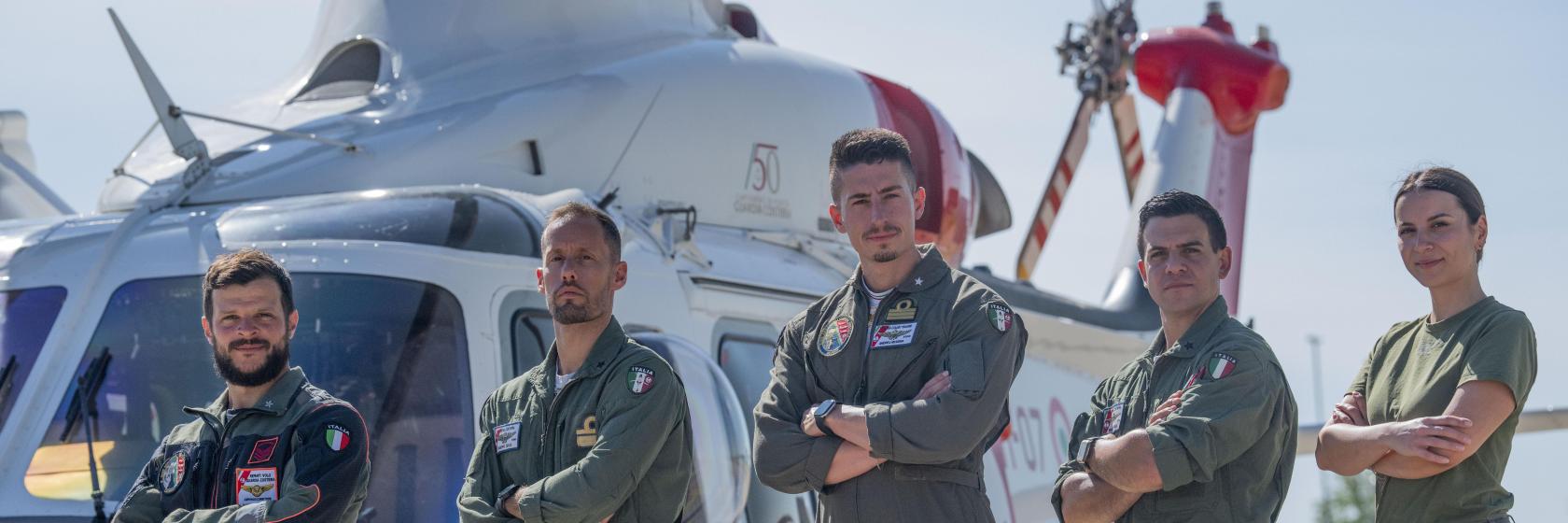
The Italian Coast Guard – Guardia Costiera – plays a vital role in safeguarding lives at sea. With an area of responsibility that spans 500,000km2 and 8,000km of coastline, one of its primary missions is to provide a 24/7 search and rescue (SAR) capability using a fleet of 16 AW139 helicopters. Catania Coast Guard Air Base in Sicily is on the front line of these SAR operations.
“We don’t know what the call will be or when it will come, but we have to be ready.” In one sentence, Guardia Costiera pilot Andrea Messina sums up the mindset of performing helicopter search and rescue operations at sea: Be prepared for everything.
The missions that Guardia Costiera crews face are incredibly varied, but some incidents stay with him. Like the emergency call to evacuate a pregnant woman on board a ship whose unborn child was in distress and would die without rapid medical intervention. “These sorts of scenarios bring home why the work we do is important. It’s our job to help people in need when they are at their most vulnerable.”

Catania Air Base on Sicily’s east coast is one of four strategically located across Italy that provide the backbone of the nation’s airborne Coast Guard operations. The others are Sarzana Air Base in Liguria, Pescara on the Adriatic Coast, and Cagliari on the island of Sardinia. The AW139 ‘Nemo’ fleet operates alongside other Guardia Costiera air assets including the fixed-wing ATR42 Maritime Patrol aircraft and the Piaggio P180 Avanti II.
From Catania, AW139 crews cover the whole of Sicily and can respond to calls from as far north as Campania, while the base also has responsibility for the Pelagian islands, including Lampedusa, Italy’s southernmost point. The island, located between Malta and Tunisia, is one of the main entry points for migrants making the dangerous crossing of the Mediterranean Sea to enter Europe from North Africa.
“Nine out of 10 calls we receive involve search and rescue missions,” says fellow AW139 pilot Giuseppe Zecca. “But we also perform other roles such as maritime policing, operations to combat illegal fishing, protecting the marine environment and ensuring safety of navigation for vessels in Italian waters. The primary mission though, is SAR.”

Emergency calls are handled initially by the International Maritime Coordination Centre in Rome before being routed to the most appropriate air base. “We respond to all kinds of situations,” says Zecca. “It could be a person in the water, a capsized vessel, or someone who has been taken seriously ill on board a ship.”
For each SAR mission, the AW139 is crewed by two pilots, a hoist/system operator and a rescue swimmer. The four-person crew can also be supplemented by a doctor depending on the nature of the medical emergency.
During our visit to the base, the weather is clear and the sea relatively calm. But that is not always the case. “Weather is our biggest operational challenge, together with the distances we fly,” explains Zecca. “The complexity of SAR operations over water rises significantly in adverse weather conditions such as storms, low visibility or high sea states.”

Catania is home to a seven-strong fleet of AW139s, although aircraft can be redeployed to other bases depending on operational requirements.
How valuable is the AW139 to Guardia Costiera’s operations? “It’s indispensable,” says Zecca. “The helicopter is absolutely vital for us. The first word that comes to mind with the AW139 is versatility – it gives us all the capability we need to perform a whole range of different missions. It’s an aircraft with a great combination of speed, range and endurance, which are essential for the SAR mission, as well as a large cabin.”
For SAR operations the AW139s are equipped with a double hoist, radar and Forward-Looking Infrared (FLIR). “The helicopters we fly also have the latest Phase 8 avionics,” explains Messina. “As a pilot, this new software is an important improvement. It gives us greater visual clarity and situational awareness, with more information at our fingertips, particularly when we are operating in marginal weather conditions.”
What about the importance of teamwork between the crew members? “Every mission we perform needs precise coordination at every stage,” comments hoist/system operator Roberto Vella. “We have to trust each other completely. As rear crew, we trust the pilots to position the aircraft exactly where it needs to be so that we can perform the winching. At the same time, we are their eyes in the back of the aircraft.”
Rescue swimmer Gianluca Capuano agrees: “SAR is a very dynamic operation. For example, if we are winching onto the deck of a ship that is moving up and down in the water, there is no margin for error. When we receive a call, there is always a moment of adrenaline, but then it’s all about the mission. Locate the casualty and get help to them as soon as possible.”
Spending time with the crew, it’s clear that training is a vital and constant part of their routine, with regular training flights to ensure every aspect of the operation becomes instinctive. Meanwhile, to maximise operational availability of the AW139 fleet a team of maintenance specialists is in place at the base to perform maintenance tasks and troubleshoot issues. Flight technician Emanuela Lozzia previously worked in the airline industry but retrained in a technical role with Guardia Costiera. She says: “Our job is all about operational readiness and making sure the aircraft is available to fly. If there is a technical issue, we have to respond quickly. Of course, safety is always the number one priority.”

I am interested to know why Messina choose this career path. What is the motivation?
“First of all, I love to fly, but more than that there is a sense of doing something positive and worthwhile on behalf of the Italian people. We are all committed to the work we do and in many ways it’s like being part of a family.
“Not every rescue can be successful. Very sadly, we have to deal with situations where people lose their lives despite the efforts of everyone involved. All we can give is the maximum in every situation. We always hope for the best, but sometimes we lose people. It’s tragic, but we understand it is part of the job that we do.
“I’m proud to fly the AW139. As a SAR crew, we are always learning. This is not a job where you learn one time and then you stop. Every day, we strive to keep improving.”
Not just improving but also living up to the Guardia Costiera motto, which in Latin reads: Omnia vincit animus. Spirit conquers all.


 Media Hub



 Civil/Parapublic


