
Financial highlights
Last trade 46.49€
Variation +1.50%
09/10/2026 - 04:19 PM
data source: Investis Digital
Financial highlights
Last trade 46.49€
Variation +1.50%
09/10/2026 - 04:19 PM
data source: Investis Digital
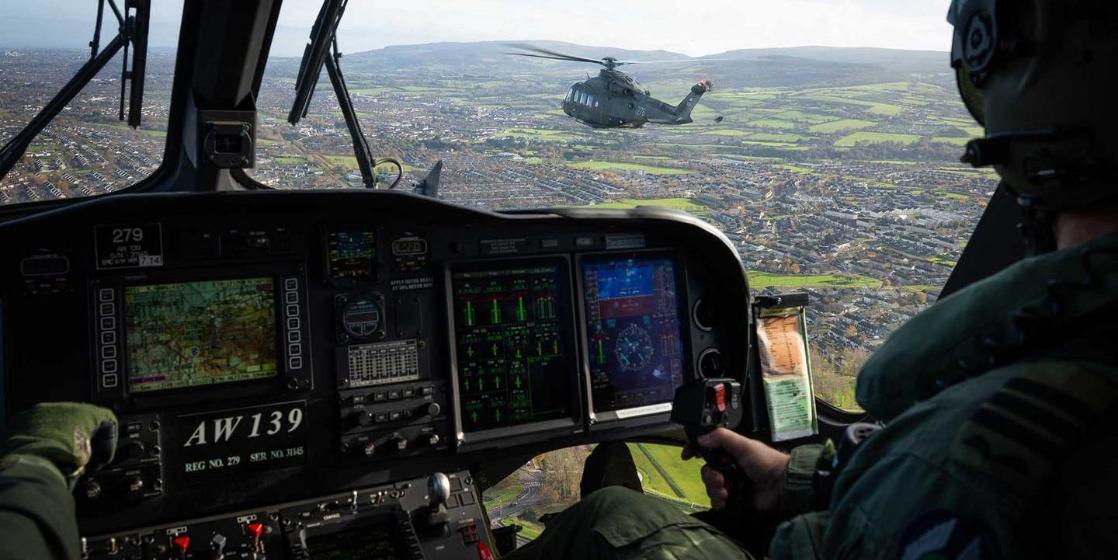
The Irish Air Corps operates a fleet of six AW139M helicopters, conducting missions ranging from troop transport and Special Forces operations to a lifesaving nationwide Emergency Aeromedical Support service. Spending three days with members of 301 Squadron, No. 3 Operations Wing, one thing becomes abundantly clear. They are ready to respond to every kind of challenge.
Versatility is a word that comes up frequently during our time with 301 Sqn of the Irish Air Corps. Versatility of people and versatility of platform. The ability to adapt and respond to multiple missions – both military and non-military – is central to the ethos of the entire operation.
No. 3 Operations Wing is based at Casement Aerodrome in Baldonnel to the southwest of Dublin. It is currently Ireland’s only operational military airbase, with both fixed and rotary wing platforms operating from the base. The weather during our visit could be described as ‘typically Irish’. Windswept one minute, low cloud the next, followed by the briefest hint of warm sunshine.
Lt Col John O’Keeffe is Officer Commanding No. 3 Operations Wing. He says: “You could describe us as being like a Swiss army knife. Whatever the challenge, we find a way to get the job done.
“301 Squadron is our primary military tactical helicopter squadron, and we cover a very wide spectrum of missions. So, we need a helicopter that brings multi-role capability. The AW139 is the backbone of our operations and gives us that versatility – enabling us to conduct all our missions successfully.”
The Air Corps has a unique connection with the AW139. As the launch customer for the militarised version of the platform in November 2006, Air Corps crews have been operating the helicopter from the start of its in-service life. And with a 20-year anniversary fast approaching, the fleet is in demand more than ever.
Moving troops and equipment quickly and efficiently is a ‘bread and butter’ role for the Air Corps’ AW139s, which operate with a crew of two pilots plus one rear crew member. The helicopter is also used for HEMS missions (see below), as well as winching operations in both land and maritime settings. It is a key platform to support the Army Ranger Wing – the elite special forces unit of the Irish Defence Forces, enabling troops to hone skills such as fast-roping techniques.
The aircraft is also equipped for aerial sniping and aerial gunnery missions, while it can be called on to perform aerial firefighting/bambi bucket operations in the summer months to combat gorse fires.
A unique aspect of the Air Corps’ AW139 operations is the Emergency Aeromedical Support service (EAS), a joint operation with the Health Service Executive (HSE), providing a rapid response capability across the nation.
For EAS taskings, the crew comprises two pilots, one rear crew member and a civilian advanced paramedic belonging to the National Ambulance Service. A dedicated AW139M operates from Custume Barracks in Athlone, Co. Westmeath. It enables patients in critical need to be treated on scene and then rapidly transported to the most appropriate hospital.
Initially launched in 2012 as a 12-month trial, the AW139 became the platform serving the operation in July of that year. The EAS has completed more than 4,500 lifesaving missions since its inception, with one aircraft from 301 Sqn dedicated to the EAS mission at any time. The interior is equipped with two rows of seats and space for one stretcher patient. There are also a LifePort system, medical rack, advanced paramedic bag, drugs and blood bags, defibrillator and spinal board.
Capt Jason McDermott – EAS Detachment Commander and 301 Sqn pilot, says crews need to be prepared for any type of scenario. “We can be called to a road traffic collision or to the aid of someone with a serious heart issue. We are typically airborne within 10 minutes of an emergency call and the fact that Athlone is centrally located means we are ideally placed to reach the scene quickly, particularly in rural areas.”
Fellow 301 Sqn pilot Captain Cayman Roe describes the sense of purpose he gains from being part of the EAS: “You are making a difference to people’s lives. It brings a different dimension to the work we do as squadron, and I relish that aspect of the role. I also enjoy the level of capability of the AW139 gives us. I previously flew on a smaller helicopter type and the extra power and technology on board are a big plus.”
Alongside flight crew, there is a vitally important ground support operation for the AW139 fleet, with Air Corps technicians responsible for keeping the helicopters in the air – a dedicated military team supplemented by a small, embedded team of Leonardo personnel.

During our stay, we also gain an insight into the forensic level of planning that goes into every mission. Before each flight, the crew takes part in a structured briefing that includes the status of the aircraft, weather data and a detailed breakdown of the tasking.
Our visit coincides with aircrew selection week, a physically and mentally demanding series of challenges to identify candidates to join the squadron as rear crew members. It includes physical training, classroom learning and presentation tasks as well as a notoriously difficult ‘downwash test’.
We see for ourselves what is involved. Candidates are required to jump 40ft from a bridge into open water – a reservoir half an hour’s drive from Casement Aerodrome – before having to swim ashore while being battered by the downwash of an AW139 in the hover at 30ft. Rescue swimmers are in the water to ensure safety, but even so, it looks brutal and is brutal.
“The spray from the downwash hits you like pebbles and makes it very difficult to breathe,” says Comdt Eugene Mohan – Officer Commanding 301 Squadron, who on this occasion is in the water as a rescue swimmer. “Selection is tough, but we need to find the right calibre of individual, so we push them hard.”
While the AW139M fleet will likely remain in service beyond 2030, the Irish Defence Forces are beginning the process to identify a long-term replacement with a planned acquisition programme for a larger ‘super-medium class’ helicopter, for which Leonardo plans to offer the AW149 as its solution.
Meanwhile, the Irish Government is also planning a major expansion of Casement Aerodrome to accommodate the Air Corps’ growing fleet of helicopters and fixed-wing aircraft.
The final word goes to Lt Col O’Keeffe: “The AW139 plays an intrinsic role in what we do here within the Air Corps. We’re proud of our long association with the platform and the story is not yet complete. We’ve a good few more chapters yet to write.”
In September 2023, an extraordinary joint operation involving the Gardai (Irish Police), customs and Defence Forces led to the largest seizure of cocaine in Irish history. When elite Army Rangers fast-roped from an Irish Air Corps AW139M helicopter onto the Panamanian cargo ship the MV Matthew, authorities recovered 2.2 tonnes of cocaine, valued at €157 million.
This is a personal account of how the events unfolded from one of the Irish Air Corps pilots involved.

“The first I knew of the operation was when I received a call at home around 7am to say that there was a vessel of interest off the southern coast of Ireland and that a potential interdiction might be required.
“The bulk carrier MV Matthew had departed Venezuela and made its way across the Atlantic. Following a surveillance operation, a decision was taken to deploy the Irish Navy to intercept the vessel.
“It was complex scenario. There had been an incident 24 hours earlier when a fishing trawler ran aground as it prepared to rendezvous with the MV Matthew and two crew members had to be winched off the deck. Meanwhile, the captain of the MV Matthew radioed to say that he had been taken ill and was also winched off the ship.
“We had a three-person crew ready to deploy. The AW139 was equipped with fast ropes and armed with a GPMG (general purpose machine gun).
“A Navy vessel pursued the MV Matthew and attempted to direct it to head for Cork, but the vessel was non-compliant and making desperate manoeuvres in an attempt to reach international waters. It became apparent that Special Forces involvement might be needed and that we could be called on to deploy the Army Ranger Wing onto the vessel.
“We flew to Waterford Airport where we were briefed on the rules of engagement, and we collected the first stick (team) of seven Army Rangers who would be first to board the vessel. For me, this was the moment it became very real. There were certainly moments where I thought: is this actually happening? It was a surreal experience, but then you go into pilot mode.
“We approached the vessel from the rear, flying at about 200ft. Conditions were difficult with 15kt to 20kt winds and a three to four-metre swell, which meant the vessel was rolling quite significantly.
“I flew down the left side of the ship and turned into the wind, putting the aircraft into a stable hover. The Army Ranger team then fast-roped one after the other from a height of around 55ft onto the vessel. Sitting over the deck, the enormity of it hit me. There was no room for error.
“As the Rangers fast-roped down, the vessel itself was turning, which made it even more difficult to position the aircraft precisely. From the radio traffic, it was clearly a ‘contested boarding’ with some resistance, but no shots were fired.
“We returned to pick up two more ‘sticks’ of seven Rangers, and repeated the fast-roping operation. As we were due to pick up the fourth stick, we received word to stand down because the situation was under full control.
“Looking back on it now, the operation was a remarkable example of the tangible contribution that the Irish Air Corps makes to the security of the nation and it is a day I will never forget.”
• Earlier this year, eight men were given prison sentences of between 13 and a half and 20 years for their role in the international narcotics operation.
Visit the AW Vertical View homepage

 Media Hub



 Civil/Parapublic


