
Financial highlights
Last trade 50.42€
Variation +4.73%
16/10/2026 - 05:38 PM
data source: Investis Digital
Financial highlights
Last trade 50.42€
Variation +4.73%
16/10/2026 - 05:38 PM
data source: Investis Digital
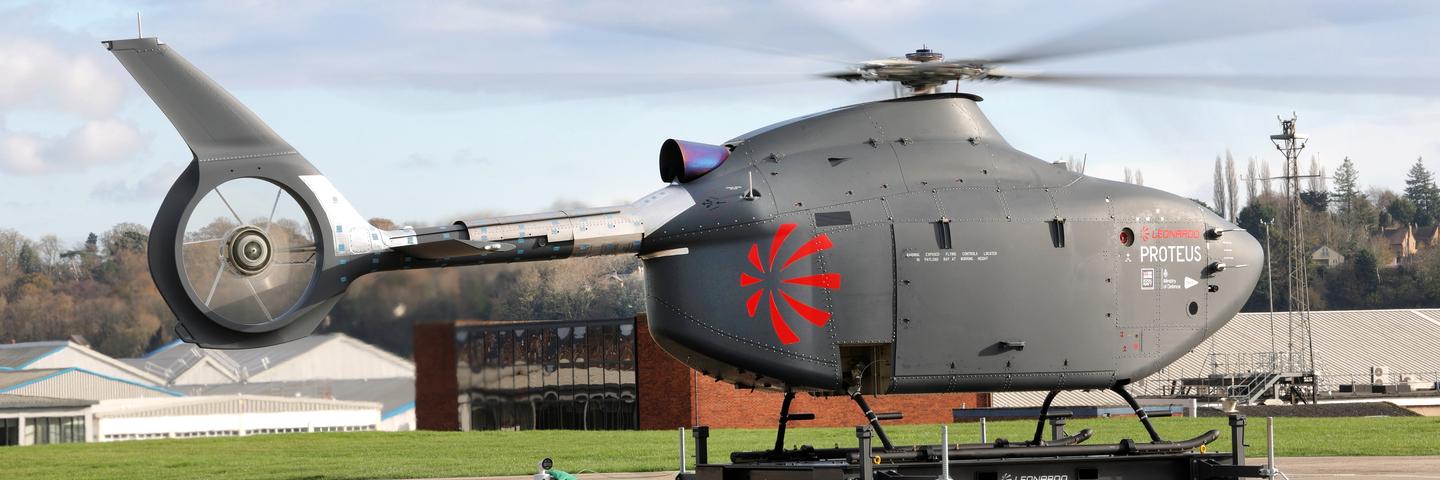
Autonomy is becoming increasingly significant for both civil and military applications, delivering important benefits in terms of safety, efficiency and capability. Take a step inside the work Leonardo Helicopters is doing to advance autonomy in the world of vertical lift.
In treacherous conditions over the North Atlantic, a Rotary Wing Uncrewed Aircraft System (RWUAS) searches for submarines in the dark. It is capable of remaining airborne for hours at a time, scouring heavy seas, while making decisions autonomously on the route and tasks it should perform. And with no crew on board, a potentially dangerous mission can be completed without placing aircrew into harm’s way.
This scenario is part of Leonardo’s work on the Proteus RWUAS technology demonstrator in the UK (described below) and is an example of how autonomy has the potential to transform operations traditionally performed by crewed aircraft.
For Leonardo Helicopters, autonomy is a key focal point of our Technology & Innovation (T&I) efforts and our single largest area of research. “We are focused both on improving the capabilities of our helicopters today and investing in technology that will shape the platforms of tomorrow,” explains Giovanni Novembrini, who is responsible for autonomy within the T&I team.
Novembrini says it is important to differentiate between full autonomy and remotely piloted operations, which include an element of automation.
“By autonomy we are speaking about the helicopter or platform having a level of ‘decision-making’ capability – for example, how to perform or alter a search and rescue pattern to achieve the best outcome. And things like the ability to adapt the mission based on sensor and communications inputs to manage situations in real-time.
“To enable the shift towards uncrewed operations, as well as teaming between crewed and uncrewed platforms in the future, autonomy is mandatory.”

The work we are doing on autonomy, is focused on three main benefits:
We are pursuing autonomy in two complementary ways. Firstly, in the synthetic environment, we are using advanced simulation to better understand how we can apply new technologies.
Secondly, we are committed to building what we term a ‘Flying Lab’, which will act as a live testbed for autonomous technologies before they are applied to the Leonardo Helicopters product line.
Novembrini explains: “The Flying Lab will be based on the SW-4 airframe and will give us a really powerful platform to explore and test autonomous capability. It will fly as an optionally-piloted vehicle, operating with a safety pilot on-board. We are advancing with this initiative, and we plan to achieve first flight at the end of 2026.”
Development of the ‘Flying Lab’ is part of a progressive approach outlined in our autonomy roadmap: “Autonomy should not be seen as one giant leap in technology,” says Novembrini. “It requires a series of incremental advancements, starting with extending existing functionalities such as automatic take-off and landing, and enabling automatic target recognition for SAR missions, for example.
“Over time, we will then progress into more complex areas such as optimising flight paths automatically, and AI-enhanced wire detection. Finally, further into the 2030s, the focus will move on to capabilities that enable networked missions such as Crewed Uncrewed Teaming (CUC-T), swarming drones, and autonomous search.
“Although much of this development is happening inside the company, collaboration with external partners such as universities and research institutes is vital. We also tap into the work being done by the Leonardo Labs – the company’s network of technology incubators that carry out long-term research and development into innovative technologies in fields such as artificial intelligence and autonomous systems.”
We have been partnering with the UK Ministry of Defence for over a decade to advance RWUAS capability. The latest phase of that work is the Proteus programme, a collaborative effort involving Leonardo, the Royal Navy, and UK Defence Innovation (UKDI) to develop a three-tonne class uncrewed rotorcraft demonstrator.
Proteus is designed to demonstrate advances in autonomy and payload modularity and interchangeability, as well as exploring the viability of Large Autonomous Vertical Take-Off and Landing Uncrewed Aircraft Systems (VTOL UAS) for military maritime operations.
In July 2022, Leonardo was awarded a four-year £60 million contract for the RWUAS Phase 3A Technology Demonstrator Programme. Designed, developed and tested at our Yeovil facility in the UK, the programme has been advancing at pace since then.
Proteus will enable the Royal Navy to deploy mass for long durations for what are termed ‘dull, dirty and dangerous missions’ and forms a key part of the Navy’s Maritime Aviation Transformation (MATx) strategy – which covers the evolution of maritime aviation out to 2040.
“It’s been a huge pleasure to work with Leonardo and across Defence, as one team, to deliver Proteus,” said Captain David Gillett, head of Maritime Aviation and Carrier Strike in the Royal Navy’s Develop Directorate.
“It combines cutting-edge technology, the experience of recent conflicts and has enormous potential to shape the Royal Navy’s future hybrid air wing”.
Read more: Royal Navy’s first crewless helicopter one step from maiden flight

Interoperability between platforms will be fundamental for the future development of autonomy. We played a key role in demonstrating how crewed and uncrewed platforms could operate together to improve mission effectiveness through the European MUSHER programme (Development of a generic European Manned unManned Teaming - e-MUMT- system) initiative funded By the European Union under the European Defence Industrial Development Programme (EDIDP-091). Coordinated by Thales, MUSHER involves several industry partners and players including Leonardo, Airbus Helicopters, Indra, Thales Edisoft Portugal and Space Applications Services.
During trials conducted in Grottaglie, Italy in 2024, our participation centred on two platforms – an AW189 super medium twin-engine helicopter with pilots and rear crew on board and the SW-4 Solo RUAS/OPH (Rotorcraft Uncrewed Aerial System/Optionally Piloted Helicopter) Technology Demonstrator, which had a safety pilot at the controls.
The trials demonstrated the capability of the AW189 crew to take control, at various levels of Interoperability, of the remotely piloted aircraft, including visualising SW-4 Solo payloads.
Simultaneously, industry partners successfully accomplished similar activities in France using a helicopter and a Rotary Wing Uncrewed Aircraft System (RWUAS). Crucially, the flight trials demonstrated connectivity between the platforms of different partners, a critical step towards full interoperability.
MUSHER follows other CUC-T demonstrations performed over the years, including the involvement of an AW159 multi-role naval helicopter and remotely piloted system in the UK. CUC-T is also one of the capabilities at the core of the Italian Army’s NEES (Nuovo Elicottero da Esplorazione e Scorta) AW249 programme.
The excellent results of the trials further strengthen Europe’s sovereign capabilities in advanced aerospace and defence technologies through industrial collaboration supported by the EU.

In partnership with deep-tech company Shield AI, we recently completed a successful flight demonstration of ViDAR, Shield AI’s visual detection and ranging system, aboard the Leonardo SW-4 helicopter.
The AI-enabled system operates as a passive wide-area search payload for both land and maritime environments. It can detect and track thousands of small objects and anomalies in real time across a wide area, significantly reducing the cognitive load on the operator.
For example, at sea the system can detect people in the water, objects with a low radar cross section, and so-called ‘dark vessels’ which have their Automatic Identification System (AIS) switched off. On land, it detects, locates, recognises and tracks stationary targets and moving vehicles across diverse terrains.
The SW-4 served as the testbed for the ViDAR demonstration, with flights conducted in October at Taranto-Grottaglie Airport in southern Italy. The testing highlighted how Shield AI’s autonomy and sensing capabilities can enhance intelligence, surveillance and reconnaissance (ISR) and search and rescue (SAR) missions and enable future integration across the Leonardo fleet.
“Demonstrating ViDAR in Europe highlights how Shield AI’s technology can strengthen the ISR and SAR capabilities of our NATO allies and partners,” said Christian Gutierrez, vice president of Hivemind Solutions at Shield AI. “Our goal is to make advanced, AI-driven sensing available to trusted nations, enabling greater situational awareness, interoperability, and mission success in contested environments.”
Emanuele Bezzecchi, Leonardo Helicopters AI Roadmap Manager, added: “This exercise is part of ongoing activities between Shield AI and Leonardo Helicopters to explore how to deliver autonomous situational awareness across Leonardo products.
“The integration of ViDAR onto our SW-4 helicopter demonstrates how next-generation AI-based sensing can transform ISR operations. The success of this demonstration has generated strong internal momentum to explore ViDAR integration across additional special mission helicopter models, both in production and under development.”
Visit the AW Vertical View homepage

 Media Hub



 Civil/Parapublic


