
Financial highlights
Last trade 50.42€
Variation +4.73%
16/10/2026 - 05:38 PM
data source: Investis Digital
Financial highlights
Last trade 50.42€
Variation +4.73%
16/10/2026 - 05:38 PM
data source: Investis Digital
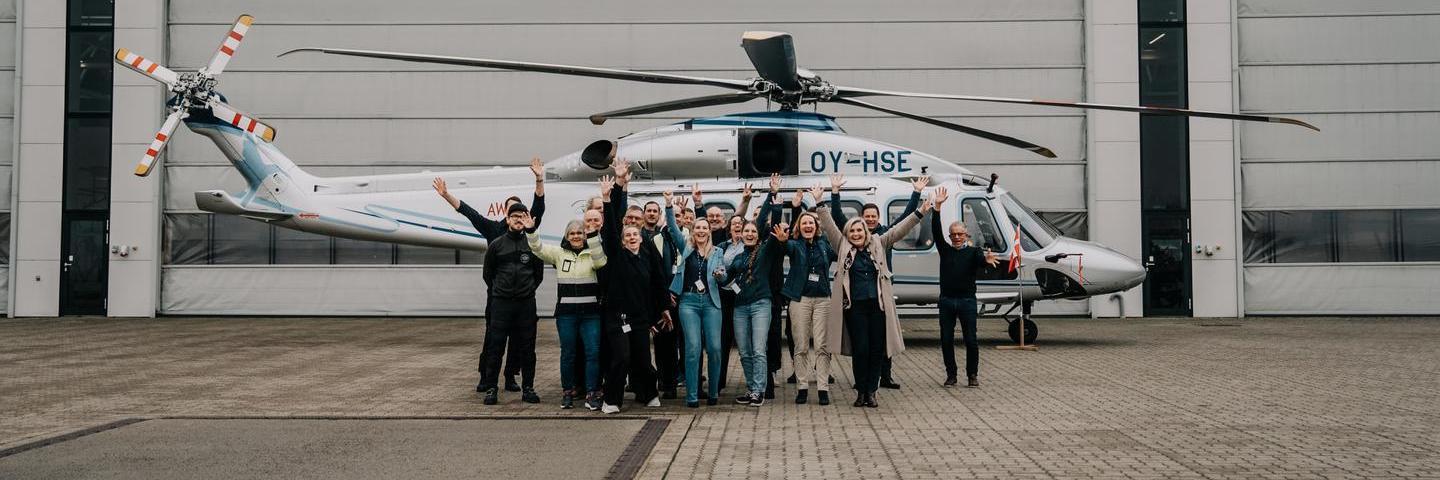
Bel Air Aviation operates a mixed fleet of AW139 and AW189 helicopters serving the offshore community from bases at Esbjerg in Denmark and Den Helder in the Netherlands. The company has grown to become a key player in the offshore sector, but also retains a unique family feel with people at the heart of everything it does.
Bel Air’s Founder and Managing Director Susanne Hessellund describes the experience of growing the business into an internationally respected offshore helicopter company as “a fantastic journey”. Like all great stories, it features moments of triumph and adversity, successes to celebrate and giant-sized hurdles to overcome. Yet what began as a bold idea and a single aircraft back in 1994 has been transformed into a thriving multi-national operation serving offshore oil and gas customers with a growing fleet of Leonardo AW139 and AW189 helicopters.
Visiting Bel Air’s purpose-built ‘home base’ at Esbjerg Airport, it is quickly apparent that the ethos of the company is incredibly important: “People and relationships. Those are the two most critical elements of how we operate,” says Susanne. “I believe we have the best team of people in the world because they care for each other and no matter how big the challenge, we always find a way to get the job done.”
It's an ethos that is reflected in the company’s motto: ‘Where there’s a will, there’s a way’, which sums up the commitment of the team to serve customers. Susanne explains: “The relationships we have with our customers and partners are built on trust. Our customers place their trust in us to transport their people offshore efficiently and to bring them home safely. To do that, we need the right helicopter fleet and also the great work of our team to do the best possible job on every single flight.”
Today Bel Air operates a fleet of three AW139 and three AW189 helicopters. The 16-seat AW189 forms the core of operations from Esbjerg, while the AW139, configured to carry 12 passengers, operates out of Den Helder – the northernmost point of the North Holland peninsula.
The size of the Bel Air team has grown substantially in recent years, now numbering almost 100 employees. Its modern facility at Esbjerg opened in 2014 and is ideally located for the ‘crew change’ operations that form 99% of day-to-day operations, with the Danish sector of the North Sea right on the doorstep.
During our visit, there is a steady drumbeat of flights, transporting offshore workers to and from platforms located anywhere up to 170nm offshore. With the North Sea being home to huge investment in offshore wind installations, Bel Air also has a growing capability to support offshore wind operations.
“Crew change operations are essential for our customers to be able to manage their operations effectively,” explains Head of Flight Operations Lars Hilgert. “We have highly qualified pilots, both on the AW189, on the AW139 and some who are dual-rated.
“The operations from our two bases are quite different. Typically, we fly further offshore from Esbjerg, which is suited to the AW189’s long-range capabilities and the work is more contractual. In Den Helder we do a lot more ad hoc flying with the AW139 where customers might need extra capacity at short notice. We also fly to a larger number of locations in the southern North Sea – something like 80 helidecks and 30 different vessels.”
He adds: “I would say that adaptability is one of Bel Air’s biggest strengths, it’s in our DNA and it’s very important in offshore operations because we need to be responsive and flexible when our customers come to us with a requirement or a problem.”

Operating as an approved Leonardo service centre and one of a small number worldwide with the ‘Excellent’ designation, Bel Air has its own EASA Part145 approval and Part M organisation.
“We provide maintenance for both our own AW139 and AW189 fleet and also for third-party customers,” says Jan Levsen, Technical Manager. “This includes checks and certification of key safety components such as life rafts, floats, and tyres. As well as the hangar here in Esbjerg, we also have line maintenance capability in Den Helder.
“Across both bases, it’s our job to keep the fleet in the air and the number one priority is safety. It underpins everything we do. We have a very well-qualified and capable team, who are a vital part of our day-to-day operation.”
Although Bel Air’s business today is dedicated to the offshore sector, in its early days the company looked very different, starting out with just one single-engine helicopter offering pleasure flights in Denmark.
Susanne says the decision to target the offshore market was “a leap of faith”. For the first few years, she operated the helicopter herself while also flying for offshore operators including Maersk and CHC. She understood that an opportunity existed in the offshore market. “Some customers were not getting the service they needed. We knew we could do a great job, given the chance.”
In 2002, she left a stable job and co-founded a new offshore helicopter company called DanCopter, working tirelessly to grow the business. Bel Air continued to operate in parallel. Then in 2007, Susanne sold all her DanCopter shares, left the company and turned her attention to transforming Bel Air into a robust operation ready to succeed in the offshore sector.
The arrival of Bel Air’s first AW139 in 2009 cemented its commitment to offshore work and the company quickly secured its first offshore contract with Maersk in 2010 and a second five-year agreement a year later. Two more AW139s joined the fleet, followed by a landmark acquisition of two AW189s in 2014.
By 2015 Bel Air had become the fleet leader for the AW189 worldwide and the company added a third AW189 in 2024, the same year that it celebrated its 30-year anniversary alongside the milestone of 100,000 safe offshore landings.
One of the most important milestones in Bel Air’s development came in 2023 when it won a contract with TotalEnergies for helicopter transport services out of Esbjerg. The company built on this success by securing a new long-term contract with TotalEnergies in 2025. This will run from 2026 to 2031 with an option for another five years and see Bel Air provide all offshore flights out of Denmark for TotalEnergies using two AW189s. The aircraft will transport personnel between seven platforms and additional drilling and accommodation rigs in the Danish sector of the North Sea.

The company’s growth journey has not always been smooth. In 2017, after a downturn in business and the loss of contracts out of Esbjerg, Bel Air found itself with five aircraft and 75 employees but no active contracts.
“That was a tough moment,” recalls Susanne. “The oil price was down. We went from operating 14 flights daily to zero. I remember very clearly being advised that the best course of action was to close down the company. But we were determined to carry on.
“In July 2017 we made the decision to pivot our operations by setting up a new operational base in Den Helder in the Netherlands serving the Dutch sector of the North Sea. We were up and running incredibly quickly thanks to the team’s commitment.
“At that time, the support we received from Leonardo was vital. They stepped up and were a small part among many others of helping us through a difficult period and I think that strengthened our relationship even more because they believed in what we were doing.”
Why did Bel Air choose the AW139 and AW189 as the basis for its fleet? “Safety, performance and payload are so important in offshore operations,” says Susanne. “The AW139 is simply the best helicopter in its class, which made the decision very easy. Its OEI [One Engine Inoperative] performance means that at the most critical time, you can still perform your flight profile.
“Likewise, the additional size, safety, range and payload of the AW189 has added a new dimension to our operations. The gearbox is of utmost importance and the dryrun of the Leonardo gearboxes are second to none. Our most recent AW189 is also equipped with the Full Ice Protection System (FIPS), which means we can operate in harsh winter conditions.
“The other factor is the long-term relationship we have with Leonardo. It is mutually supportive. We have worked together for many years and we find a way to resolve issues without any finger-pointing but with the focus to become better together.”
What comes next for Bel Air? “We’re excited for what the next few years will bring,” says Susanne. “We have two more AW189s on order, which are due to be delivered in 2027 and 2028. They will support our efforts to expand the business. We’ll also continue to invest in our maintenance capability for external customers and we have plans to establish our own training department.
“We want to grow in a way that makes us stronger, while also retaining the family feel that makes us who we are. I’m really proud of our team and also the relationship we have with Leonardo. We stayed together through the tough times and we’re ready for the next chapter.”
Visit the AW Vertical View homepage

 Media Hub



 Civil/Parapublic


